
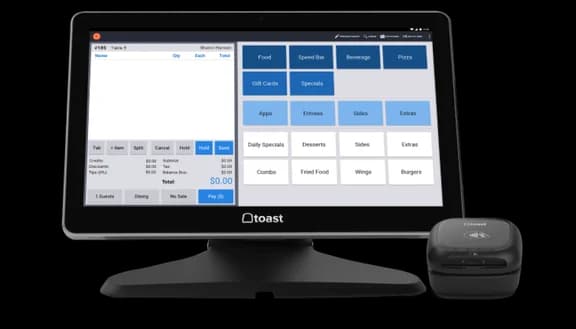

Toast POS Highlights
Toast started as a restaurant-first POS, but it now offers a retail mode and liquor store configuration. It can work well for bottle shops that also run a bar, tasting room, or food service, and it gives you a single platform for online ordering, loyalty, and in-store checkout. The trade-off is that Toast is processor-locked to Toast Payments and optimized more for restaurants than high-volume retail liquor, so long-term processing costs and inventory depth may lag behind liquor-specialized systems.
Best for Hybrid Concepts
Works best for liquor stores that also run a bar, tasting room, or restaurant and want one platform for food and retail.
Polished All-in-One Platform
Tight integration between POS, online ordering, loyalty, gift cards, and reporting, with a modern interface cashiers tend to like.
Locked to Toast Payments
You can’t bring your own processor. You’re required to use Toast Payments, which uses flat or blended rates that can get expensive at liquor store volumes.
Not Liquor-First
Solid for basic retail and bar needs, but inventory, case/bottle workflows, and liquor-specific reporting are lighter than liquor-specialized systems like BottlePOS or Korona.
In this review, we’ll break down Toast POS pricing, hardware bundles, Toast Payments processing costs, retail and bar tools, and where Toast fits versus options like Korona, BottlePOS, Lightspeed, Clover, Square, and NRS for liquor store owners.
Comparing your options? See how Toast POS stacks up in our Best POS Systems for Liquor Stores guide.
Toast POS Key Takeaways
Toast POS Top Features for Liquor Stores
Toast brings a polished, restaurant-grade platform into the liquor store space. Its strengths are in unified operations—bar, restaurant, and retail in one system—paired with a modern interface, online ordering, loyalty, and tightly integrated reporting. The trade-off is that its retail feature set is more general than liquor-specialized systems and you’re locked into Toast Payments.
Retail Mode & Inventory Management
Toast’s retail mode gives liquor stores basic tools to manage a growing catalog of SKUs alongside any food or bar menu you might run:
- Support for barcodes, departments, and product variants (sizes, flavors, packs)
- Central catalog that can power in-store POS and online ordering from the same item database
- Configured tax rules for alcohol, prepared food, and non-taxable items
- Stock counts and simple inventory reports to track what’s selling and when to reorder
It’s a good fit for liquor stores that want a single catalog across bar, kitchen, and retail shelves, but it lacks the deep liquor-specific inventory tools found in systems built solely for bottle shops.
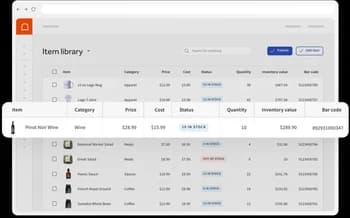
Retail inventory tools within Toast’s catalog (example layout)
Age Prompts, ID Checks & Compliance Workflows

Toast’s built-in age prompts (ID scanning requires add-on)
Toast includes the core compliance workflows liquor stores need for age-restricted sales:
- Automatic age-verification prompts on alcohol and flagged products
- Ability to require DOB entry or an “ID checked” confirmation before completing a sale
- Override and void tracking for audit and compliance reviews
- Detailed reporting on age-restricted transactions
ID scanning: Toast does not include native ID scanning. Automated ID checks require a paid third-party integration like WE SCAN, which is priced on a quote basis.
Note: Out of the box, Toast relies on manual DOB entry and prompts. If you require strict ID-scanning compliance (common in liquor/tobacco-heavy stores), expect an added cost for WE SCAN or a similar supported ID-verification partner.
Pricing, Promotions & Discounts
Toast’s pricing engine is strong on restaurant and bar promotions and can handle everyday retail discounts, but it isn’t built around the more complex bottle-shop pricing rules.
- Happy hour, time-based and day-of-week discounts
- Basic mix-and-match and multi-buy discounts for featured items
- Category- or item-level promos for wine, beer, and liquor
- Ability to pair promotions with loyalty or marketing campaigns
Where Toast falls short: it doesn’t natively support deep liquor-specific pricing logic (true case-break pricing, complex brand-family or size-based mix-and-match, and margin-optimized multi-packs) at the same level as liquor-first systems.
Strong bar/restaurant promos, lighter liquor-specific pricing
Online Ordering & Omnichannel Sales
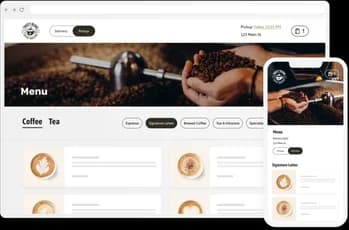
Toast Online Ordering (pickup/delivery options where allowed)
Online ordering is one of Toast’s biggest strengths if your liquor store also runs a bar, restaurant, or tasting room:
- Native online ordering site that can handle both retail items and prepared food
- Support for pickup and, where legal, local delivery or courier integrations
- Menu and catalog sync so changes in Toast flow through to online ordering
- Integration with loyalty, offers, and customer profiles
For stores that want to accept online orders without bolting on a disconnected third-party system, Toast’s built-in tools are a major advantage—especially if you already serve food or by-the-glass drinks.
Reporting & Analytics
Toast offers more robust reporting than many budget POS systems, especially if you run both retail and restaurant/bar operations.
- Sales by category (beer, wine, liquor, bar, food, etc.)
- Product mix and menu engineering reports to see top movers
- Labor, discount, and void reports for tighter cost and loss control
- Multi-location and shift-level performance insights
For liquor stores that also operate as bars or restaurants, this level of reporting can be a big upgrade. Pure bottle shops may still find liquor-first systems more tailored to their exact reporting needs.
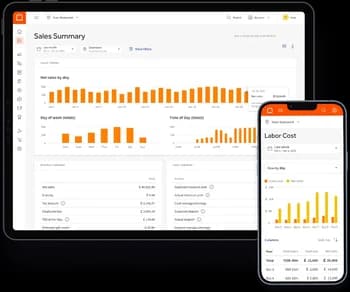
Reporting and analytics across retail and bar operations
User-Friendly Interface & Reliable Checkout Speed
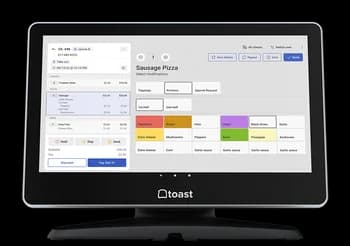
Toast touchscreen checkout (bartender/retail workflows)
One of Toast’s biggest selling points is how easy it is for staff to learn and use—especially if you have both bar and retail workflows at the front counter.
- Clean, modern touchscreen interface for cashiers and bartenders
- Fast item search, tabs, and check splitting for bar side; quick scanning and payment for retail
- Short training curve for new hires and rotating staff
If your liquor store also runs a busy bar or tasting room, Toast’s interface is a clear strength and can meaningfully improve speed of service.
Toast Payments & Hardware
Unlike some liquor-focused systems, Toast is a fully bundled solution: you use Toast hardware and Toast Payments together.
- Proprietary terminals, handhelds, kitchen displays, and accessories
- All card-present and online transactions routed through Toast Payments
- No option to bring your own credit card processor
Note: This all-in-one model is convenient but means you’re locked into Toast’s rates and hardware. At liquor store volumes, that can add up compared to a processor-agnostic POS on true cost-plus pricing.
Bundled hardware + payments model to factor into long-term cost
Toast POS Pricing
Toast structures its pricing around software plans, hardware bundles, and payment processing. For retail environments, including liquor stores, the entry price can be low, but most stores end up paying for upgraded software, Toast-certified hardware, and add-ons like advanced item management or ID scanning.
Software Plans
Retail Point of Sale Plan
Per location
- Cloud Based Point of Sale
- Inventory & retail controls
- Flexible pricing & discount tools
- Better fit for liquor stores with moderate volume
Retail / Custom Plan
For multi-terminal setups or advanced workflows
- Advanced retail & liquor store features
- Multi-terminal & multi-location support
- Online ordering add-ons
- Loyalty, gift cards & integrations
- Volume-based processing rates
Note:The $69/mo plan looks affordable, but most liquor stores will still need a custom quote to access the features they actually require.
Hardware Costs
Toast retail hardware must be purchased through Toast and is not compatible with third-party equipment. Below are the most common hardware options used by liquor stores, with approximate pricing.
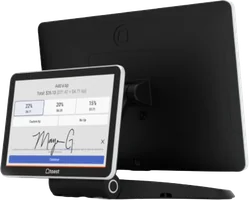
Retail POS Bundle
Full countertop setup: terminal, case, stand, card reader, receipt printer, cash drawer, cabling.
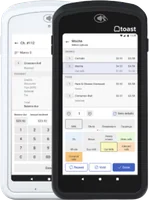
Toast Handheld
Portable handheld POS with integrated card reader; popular for curbside or peak-hour backup.
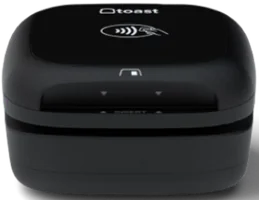
Toast Tap
Compact NFC/EMV card reader; used with the Retail POS for Apple Pay acceptance.
Payment Processing
Toast is processor-locked — all merchants must use Toast Payments. Their own published example gives a useful benchmark for how expensive that can be for liquor stores over time.
Toast Published Example
Toast keeps $0.77 per $100 sale
→ roughly 0.77% (77 bps) processor margin
on top of interchange & card-brand fees
Standard Toast Rates
Exact rates differ by plan and volume, but most liquor stores
are offered custom quote-only pricing built around that margin.
Toast’s ~77 bps processor margin adds up quickly. At $1M in annual card volume, that’s about $7,700 per year in margin going directly to Toast.
Toast is a powerful system, but its processor-locked model means your fees can rise over time with no ability to negotiate. Many liquor stores switch to processor-agnostic setups like Korona POS to keep costs competitive.
Upload a recent merchant statement — we'll quantify your savings in dollars.
Marketplace Add-Ons
Toast’s base software is limited for liquor stores. Most retailers end up adding multiple paid modules, and monthly costs climb quickly as you enable more functionality.
Loyalty Program
Digital loyalty & rewards tracking
Gift Cards
Digital & physical gift card support
Email Marketing
Automated email campaigns & promotions
Toast Websites
Branded website with your own domain
3rd-Party Ordering Sync
Sync with DoorDash, Uber Eats, Grubhub
Toast Payroll
Employee management & full payroll
Total Estimated Cost: ~$1,000–$1,600 in hardware + $150–$300/month per location once software upgrades, add-ons, and Toast Payments fees are factored in.
Calculate Your Total Cost of Ownership
📌 Note: This calculator does not include Clover's marketplace add-on app costs, which typically add $40–$150/month for essential liquor store functionality.
Quickly Compare Clover to Korona, BottlePOS, Lightspeed, and Square
Pros and Cons of Toast POS for Liquor Stores
Stores that prioritize low processing costs or deep liquor inventory tools may prefer Korona POS or BottlePOS for liquor-specific workflows and cost-plus processing flexibility.
Pros of Toast POS
Excellent for Hybrid Liquor + Bar/Restaurant Concepts
Ideal for bottle shops that also serve drinks or food — one unified system for bar, retail, kitchen, and online orders.
Modern, User-Friendly Interface
Clean, intuitive touchscreen workflow that cashiers and bartenders learn quickly. Faster checkout than many budget or legacy systems.
Strong Online Ordering & Loyalty
Native online ordering, loyalty, gift cards, and marketing tools — great for stores offering pickup, delivery (where legal), or food service.
Unified Reporting Across Retail & Bar
Strong sales, labor, discount, and product-mix reporting — especially valuable if you operate both retail shelves and a bar/tasting room.
Reliable, All-In-One Hardware
Proprietary hardware is durable, purpose-built, and tightly integrated with the Toast platform.
Cons of Toast POS
Processor-Locked to Toast Payments
You cannot bring your own processor. Liquor stores with high credit card volume often pay more over time than with true cost-plus processing.
Retail Inventory Tools Are Basic
Supports barcodes, modifiers, and stock counts — but lacks liquor-specific features like case breaks, bottle deposit workflows, vendor file ingestion, or advanced mix-and-match rules.
Long-Term Cost Can Be High
Hardware, add-ons, and Toast Payments fees add up. Over several years, total cost usually exceeds liquor-focused or processor-agnostic systems.
ID Scanning Requires a Paid Integration
Toast does not include native ID scanning; you must use WE SCAN or another paid partner for automated ID verification.
Less Tailored to Pure Bottle Shops
Built around restaurant workflows first. Pure liquor stores needing advanced pricing, purchasing, or deep inventory may find Toast limiting.
Key Takeaway: Toast is the best fit for liquor stores that also run a bar, tasting room, or food program and want a polished, all-in-one system. Stores that prioritize low processing costs or deep liquor inventory tools may prefer Korona POS or BottlePOS for liquor-specific workflows and cost-plus processing flexibility.
How Toast Stacks Up Against Other Liquor Store POS Systems
| Category |  |  |  |  |  |  |
|---|---|---|---|---|---|---|
| Processor Choice | Locked (Fiserv) | Full Freedom | Square Only | Fee to switch | BottlePOS Payments | Toast Payments Only |
| Liquor-Specific Tools | Add-ons required | Designed for liquor | Minimal | Strong options | Deep liquor features | Restaurant-first retail mode |
| Inventory Depth | Moderate | Advanced | Basic | Advanced | High-end automation | Basic retail inventory |
| Omnichannel / Online | Limited | Integrations available | Strong online suite | Robust | BottleZoo only | Native online ordering |
| Monthly Software Base | $84.95+ | $59–$69 | $49 (Retail Plus) | $109+ | $99+ (quote-based) | $69+ (retail plan) |
| Hardware Approach | Proprietary Terminals | Build-your-own bundle | Square-only devices | iPad + peripherals | Discounted hardware bundles | Proprietary Toast hardware |
| Best Fit | Simple retail setups | Owners wanting control | New or very small shops | Growing retailers | Liquor-focused stores | Liquor + bar / food hybrids |
(quote-based)
(retail plan)
Takeaway: Toast is a strong fit for liquor stores that also run a bar, tasting room, deli, or restaurant — because it combines retail checkout, tabs, online ordering, loyalty, and reporting in one modern platform. The trade-off is that Toast is processor-locked to Toast Payments and its retail inventory tools are more general than liquor-first systems like Korona or BottlePOS.
→ See our Korona POS review if you want liquor-specific tools and full processor control
Reputation Built on Restaurant-Grade Reliability (With Trade-Offs)
Toast is one of the most widely recognized POS brands in food service, and it’s especially popular with restaurants, bars, and high-volume counter-service concepts. For liquor stores that also run a deli, kitchen, tasting room, or bar, Toast’s ecosystem (online ordering, loyalty, handhelds, menu management, and reporting) is often the main draw.
Customer feedback reflects that mix of strong product capabilities—plus some common frustrations:


Users frequently highlight:
- Ease of Use — clean interface with fast training for staff
- Restaurant-Grade Features — tabs, handhelds, online ordering, loyalty, and kitchen workflows
- All-in-One Stack — fewer third-party tools needed once everything is configured
Most Common Complaint: Support responsiveness can be inconsistent, and many owners dislike being locked into Toast Payments. Pricing can also climb as add-ons and hardware are layered in—so it’s important to confirm the full monthly cost in writing before signing.
Toast is a powerful platform for hybrid liquor + food/bar concepts—but if your priority is liquor-first inventory depth, systems likeKorona POS or BottlePOS are usually a better fit.
Final Verdict: Is Toast Worth It for Liquor Stores?
Toast can be a strong choice for liquor stores that also operate a bar, tasting room, deli, or restaurant. Its biggest advantages are a polished interface, fast checkout, native online ordering, and an all-in-one ecosystem that combines POS, payments, loyalty, and reporting under a single platform.
Main Drawbacks
Toast is not liquor-first. While it supports barcodes, departments, and basic retail inventory, it lacks deep liquor-store workflows like true case-break pricing, advanced vendor management, and liquor-specific reporting that high-volume bottle shops often rely on.
Processor lock-in is the biggest trade-off. Toast requires all transactions to run through Toast Payments. For liquor stores with meaningful card volume, this can result in higher long-term processing costs compared to processor-agnostic systems using true interchange-plus pricing.
If you want a modern, easy-to-use system that unifies liquor, food, and bar operations → Toast is a solid fit for hybrid concepts.
If your priority is deep liquor inventory tools, automation, and full processor control → Korona POS is usually the better long-term choice.
Not Sure Which System Fits Your Store Best?
Schedule a consultation with our POS team — we’ll compare BottlePOS, Korona, and others based on your volume, inventory size, and budget.
FAQs
Does Toast work well for liquor stores?
Toast can work well for liquor stores that also operate a bar, tasting room, deli, or restaurant. It supports barcodes, retail checkout, age prompts, and unified reporting across food and alcohol. Pure bottle shops, however, may find Toast’s inventory and liquor-specific workflows more limited than liquor-first POS systems.
Do I have to use Toast Payments?
Yes. Toast is fully processor-locked, meaning all card-present and online transactions must run through Toast Payments. You cannot bring your own processor or negotiate true interchange-plus pricing independently.
Can I use my own processor with Toast?
No. Toast does not support third-party processors. While Toast Payments can be convenient, liquor stores with higher card volume may pay more over time compared to processor-agnostic systems that allow cost-plus pricing.
Does Toast support online ordering for liquor stores?
Yes. Toast includes native online ordering that can support retail items, food, and alcohol where permitted by local laws. This is one of Toast’s biggest strengths—especially for stores that already offer prepared food or bar service.
Is Toast a good option for multi-location liquor stores?
It depends on your operating model. Toast works well for multi-location groups that combine liquor retail with food or bar operations. For chains focused on liquor-only retail with centralized purchasing, case-break automation, and deep inventory controls, BottlePOS or Korona POS are usually a better fit.
Is Toast a good fit for small single-location liquor stores?
Toast can be a good fit if you value ease of use, modern hardware, and built-in online ordering. If your priority is liquor-first inventory depth or full processor control, Korona POS or BottlePOS are often better long-term options.